Kite Reviews
Foil Kites Explained: How They Work and When to Choose One
Give a foil kite a bit of wind and something odd happens. A bundle of fabric that looked like a crumpled duvet stiffens into a wing, tugs hard on the lines, and starts dragging you across the field. There is no frame, no pump and no bladder inside it — just cloth, air and a lot of careful sewing.
That design is why foil kites feel different from the inflatables most people meet first at the beach. Understanding how they work makes it much easier to decide whether one belongs in your bag.
What "foil" means in a kite
A foil kite is a ram-air wing. It has a top skin and a bottom skin sewn together into an aerofoil cross-section: the rounded leading edge, thick middle and tapered trailing edge you would find on an aircraft wing. Air enters through vents along the leading edge and fills the inside of the canopy, which is divided into cells by internal fabric ribs. Once those cells are pressurised, the kite holds its shape.
Paragliders and skydiving canopies work the same way. The structure is the air itself. If airflow stops — a hard crash, a sudden lull, a tangle — the wing goes limp, because nothing rigid is keeping it open.
Cells, ribs and bridles
Three things do the engineering work:
- Cells and ribs. The ribs set the thickness and curve of the wing. More, narrower cells generally give a smoother, more efficient aerofoil.
- Intake vents. Openings at the leading edge let air in and keep it there while the kite moves forward.
- Bridle lines. A web of thin lines connects the canopy to the flying lines, holding the wing at the right angle to the wind and spreading load across many attachment points.
That last one matters more than newcomers expect. A single bridle line that is a centimetre too long, knotted or frayed can make the kite pull to one side or fold a wingtip. Checking bridles is part of owning a foil, not an optional extra.
Why foil kites have no spars
Inflatables use bladders and struts; some beginner kites use rods. Foils use neither. The trade is straightforward: nothing to break, nothing to pump, but nothing to keep the wing open except internal pressure.
In practice a foil packs down small, shrugs off most crashes, and rarely needs a repair session. It is also lighter for its area, so it produces useful power in less wind than an inflatable of the same size. The flexibility has a cost: handling is softer and slower, and the canopy deforms under hard loading instead of holding a crisp shape.
What they are good at
- Power kiting and traction. Landboarding, kite buggying, snowkiting and kite foiling all suit foils well. High lift per square metre, no pump, and a canopy that soaks up gusts rather than passing every jolt down the lines.
- Buggying in particular. Small fixed-bridle foils on handles are the traditional choice: quick to set up, tough in a field, and easy to steer with one hand on each brake line.
- Travel. A quiver of foils rolls into a rucksack. No pump, no bladder spares, no awkward struts. If you are flying with hand luggage or hiking to a snow plateau, that settles it.
- Light wind. Being light and efficient, foils keep flying when heavier kites are dropping out of the sky.
Where they fall short
Honesty helps here, because a foil is not a straight upgrade.
- Water relaunch. An open-cell foil that lands in the sea fills with water and will not fly again until it is drained on land. Closed-cell versions hold their air and can be relaunched, but they are still less forgiving than an inflatable.
- Turning speed. Foils turn more slowly and need more input. In waves, that lag shows.
- Ground handling. Bridle lines find rocks, bushes and fence posts. Laying out a foil in a cramped launch spot takes longer than rolling out an inflatable.
- Power spikes. Fly a foil fast across the window and apparent wind builds quickly. The pull can arrive in a rush, especially for a new pilot.
Open-cell, closed-cell and single-skin
Open-cell kites are the simplest and usually the cheapest. Air flows in and out freely, which is fine on land, snow or a dry beach. They are the standard for buggying and landboarding.
Closed-cell kites have valves that trap air inside. The canopy keeps its shape after a crash and can be relaunched from water, which is why they appear in kite foiling and light-wind kite surfing. They cost more and pack slightly larger.
Single-skin foils drop the bottom skin entirely. They are extremely light and fly in almost nothing, making them popular on snow and in light inland winds. In gusty, turbulent air they are less settled, and they will not relaunch from water.
Choosing and flying your first foil
Start small and pick a steady day. A modest fixed-bridle foil on handles is a cheap, safe way to learn; if you are heading for a landboard, a depower foil on a bar will feel more familiar. Choose a wind you can stand up in comfortably, well below the top of the kite's range, and go somewhere with clear space and soft ground.
Before you launch:
- Lay the kite out into the wind and check every bridle line for knots, twists and wear. Compare lengths against the opposite side.
- Let the leading edge fill — hold it into the wind or pull gently on the front lines until the cells pressurise and the wing holds its shape.
- Weight or stake the kite before walking back to the bar or handles. A foil will not sit quietly in a gust.
- Check your flying lines are equal, untwisted and free of sharp edges.
Once it is flying, keep it moving. Foils behave best with steady airflow over the canopy, so park them near the edge of the window rather than overhead, and learn the reverse launch — pulling on the rear lines to back the kite up off the ground. That one skill saves a lot of walking.
After a session, shake sand out of the cells, dry the kite if it got damp, and store it loosely. Foil fabric and bridle lines last for years with that routine, and noticeably less without it.
Lastly, check the rules at any new site. Some beaches and parks restrict kite flying, and airspace restrictions apply near airports. A quick look at local guidance before you unpack saves an awkward conversation later.
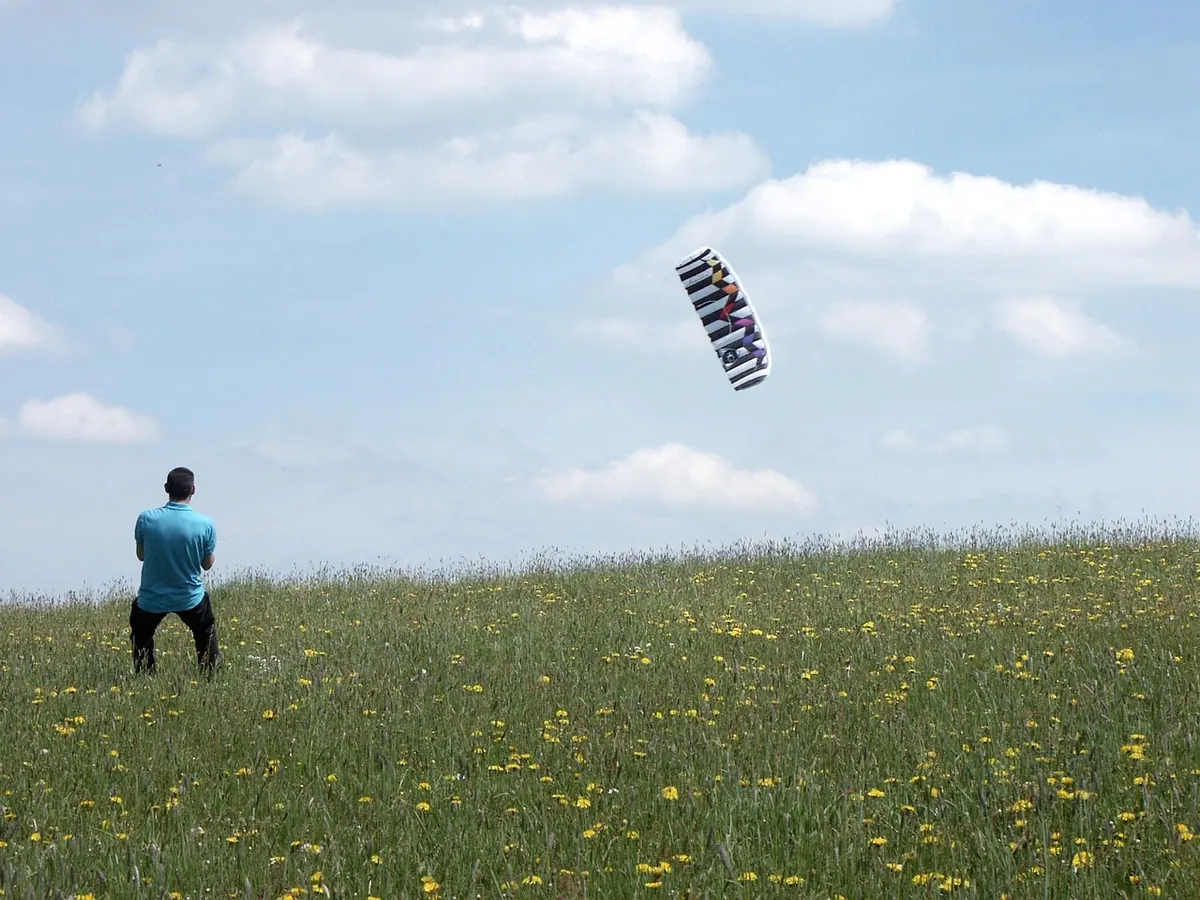
Photo: andiroth / Pixabay